
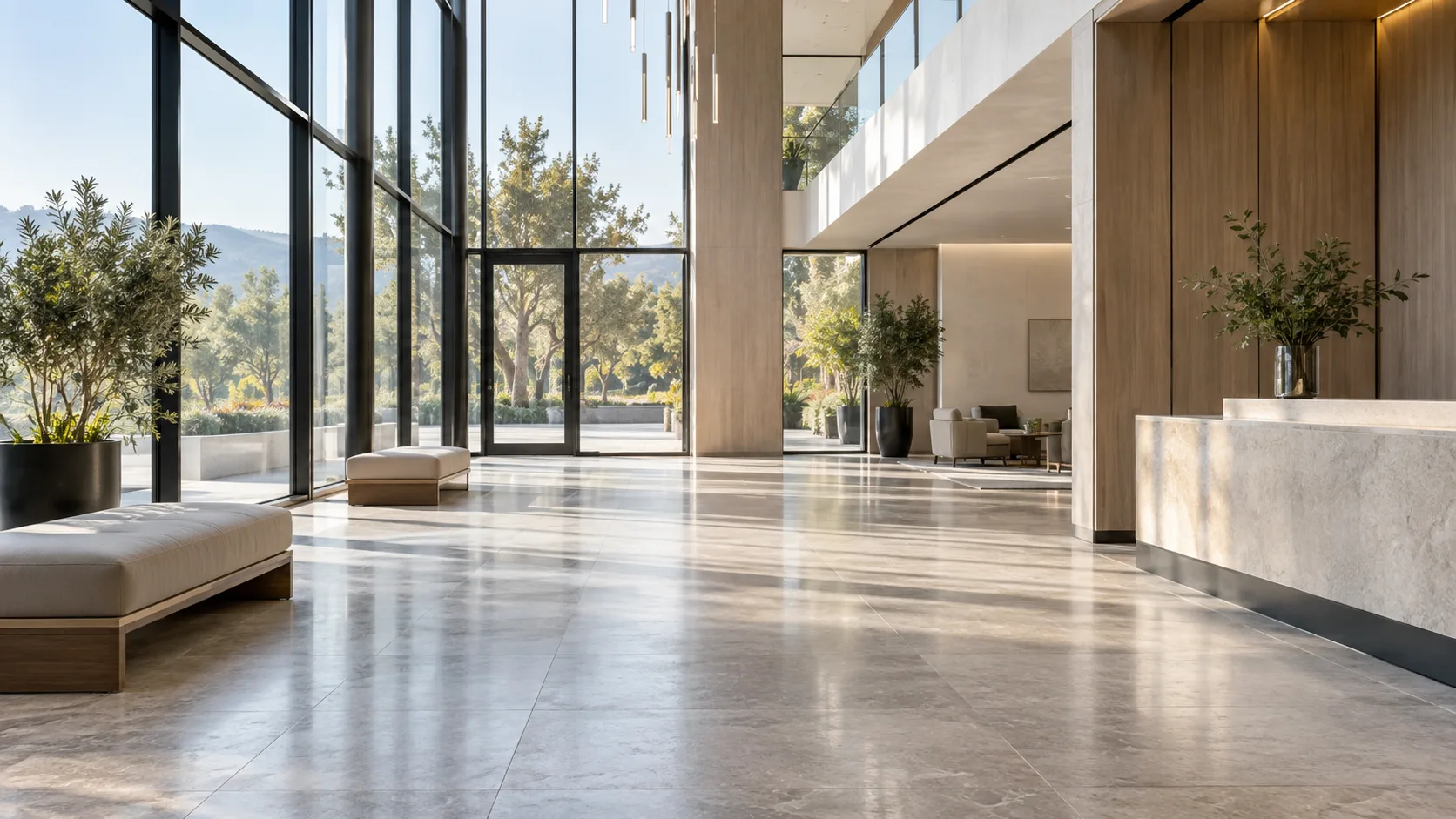
Commercial Floor Care Services
Commercial floor care for resilient tile, concrete, natural stone and your entrance mats. Ascent Cleaning scrubs, recoats, polishes and burnishes floors on a schedule that keeps them bright between deeper work.
Routine cleaning and periodic maintenance
Everyday cleaning keeps grit off the floor. Scrubbing, recoating, polishing and burnishing go further, chosen for each floor’s material, finish and wear.
Concrete, stone, and entrance mats
Concrete scrubbing lifts ground-in soil from back rooms and working floors, and natural stone and entrance mats are cleaned with methods suited to each material.
Stripping and waxing
When finish on resilient or VCT-type flooring wears through, stripping and waxing removes it and lays down fresh coats.
A floor plan for the whole building
Different floors in one building need different care. Entrance mats trap soil at the door, resilient floors in corridors need their finish maintained, and concrete in back areas needs scrubbing.
We put these together into one schedule, with stripping and waxing planned when the finish is worn through. Dealership showrooms and gym activity floors run on the same kind of schedule.
Matching each floor type to its treatment
Resilient and VCT-type floors are maintained by scrubbing, recoating and burnishing, which keep the finish layer intact and glossy. Concrete in warehouses and back rooms is scrubbed to remove ground-in soil. Entrance mats are cleaned so they keep trapping grit at the door instead of passing it inside.
Most commercial buildings have several of these at once. A medical building might pair stone in the lobby with resilient corridors, and a Stockton distribution center usually pairs office carpet with concrete on the working floor.
Marble and terrazzo lobbies
Marble and terrazzo get stone care of their own. Crews clean them with pH-neutral products that will not etch the surface, then polish the stone to bring back the depth and shine that foot traffic grinds away. Lobbies and entry halls are polished in sections overnight, so the building opens on a bright floor.
A maintenance calendar that protects the finish
Recurring cleaning keeps surface grit off the floor, and grit is what wears finish fastest. Burnishing in the main traffic lanes restores shine between deeper work. Scrubbing and recoating rebuild the finish before it wears thin, and stripping is held back until recoating no longer brings the floor back.
The result is fewer full strips and less downtime. Setting the calendar around traffic rather than dates means busy entries and corridors are serviced more often than quiet offices, and the work is planned for evenings or weekends when the floor can be closed.
Floor care by property type
Warehouses and plants in Fremont and the Central Valley need concrete scrubbing on working floors, timed around shifts; see industrial cleaning. Retail and shopping centers need sales floors bright before opening, with burnishing on a regular cycle. Schools and daycares need floor work during breaks so rooms are ready for students.
For full refinishing of resilient floors, stripping and waxing resets worn finish entirely, and regular care keeps it going from there.
What to note before requesting floor care
List each floor type and roughly where it sits in the building, along with when each area can be closed. Mention any recent refinishing or problem spots, such as stained grout or worn finish by an entry. That way the first visit uses the right method on every floor.
How floor care is budgeted
Periodic floor work is priced by the square foot, with a minimum charge for small jobs. Scrubbing, recoating and burnishing cost less per foot than a full strip because the old finish stays down, and full stripping and refinishing is priced on our stripping and waxing page. Natural stone and specialty finishes, more common in San Francisco lobbies, sit at the top of the market.
Floor care is easiest to budget as a yearly plan. Suppose a Vallejo building has 6,000 square feet of VCT corridors and entries, stripped and refinished once a year at $0.55, which comes to $3,300. Scrub-and-recoat visits between strips cost less per foot because the old finish stays down, so two of those through the year hold the gloss without a second full strip. Concrete scrubbing in back rooms and stone care in the lobby sit on their own lines in the same plan.
What moves the number: the floor material and its condition, how many coats of old finish have to come off, the coats of new finish you want, furniture and fixtures to move, and edges and corners where buildup is heavy. Work scheduled for evenings or weekends and done in sections so corridors stay open adds time, and small rooms run into the minimum charge. Regular cleaning between periodic visits stretches the time between strips, which lowers the yearly cost. We look at each floor on a walkthrough and set out its treatment and price in a quote.
A few useful answers
Frequently asked questions
What determines how often a floor needs maintenance?
Traffic, soil, floor material, and finish wear determine the interval. The condition of the floor matters more than a fixed timetable.
Can entrance mats be cleaned as part of floor care?
Yes. Your entrance mats are cleaned with a method suited to their material, so they keep trapping grit at the door.
How do we know a floor needs more than routine cleaning?
Dull traffic lanes, scuffs that do not lift with mopping, and finish worn thin near doors are the usual signs a floor is due for burnishing, a recoat or scrubbing.
Can floor work be done overnight?
Yes. Scrubbing, recoating and burnishing are scheduled after hours or on weekends while the building is closed.
Service areas
Nearby service areas
Industries
Related industries
Resources